
Tutorial 7: Simpson’s Paradox
When viewing output from death comparison searches, you must be extremely careful in how you interpret the results. A paradox often taught in introductory statistic classes is common.
For example, a simple comparison between white and black females in the US for all causes across the age categories shows the following results (in MicroMorts):
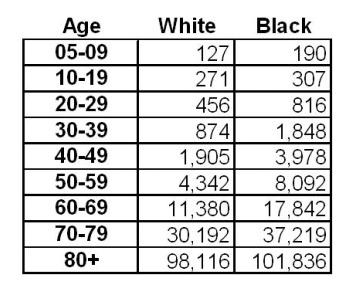
Figure 7-1: MicroMort comparison between black and white US females by age categories
For each age category, black females have much higher death risk then white females. In fact for the “30-39” and “40-49” age categories, the black female risk of dying in the next year is over twice that of the white females. This is an important fact that should generate a focused policy discussion as to the causes of the disparity.
Suppose that instead of looking at each age category, you looked at the same search, but did for all ages at once. You would get the following results:

Figure 7-2: MicroMort comparison between black and white US females for all ages
How is it possible that overall black females have much lower death risk? In every age category, whites are less then blacks, but over all blacks are less then whites!! This is a classic paradox.
This paradox was first identified in 1951 by Edward Simpson and two of his colleagues Karl Pearson and Udny Yule and came to be known as Simpson’s Paradox. It occurs because blacks and whites have different age distributions. On average, white females are older than black females, and older females have much higher risk than younger females. So, in fact when you compare the overall risk, you are comparing old white women with young black women, and the black population has less risk.
Here is the age distribution for the two groups:
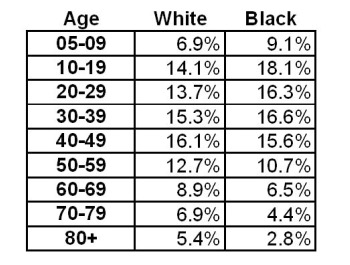
Figure 7-3: Population distribution comparison between black and white US females
For every age category “30-39” and younger, the black population has a higher percent than the white, and for every age category “40-49” and older, the white population has a higher percent than the black. This results in the average white woman being older and having higher risk than the average black woman.
A policy discussion that only looked at the overall average risk would reach the completely wrong conclusion.
Simpson’s paradox is not limited to race differences among US women. It is found throughout the death comparison data. For example, when comparing US men and women, overall there appears to be no difference, but if broken down by age categories, men have much higher risks for every age group. This is because, on average, the female population is older then the male population. US and European comparisons are also susceptible to the paradox. The European population is on average older than the US.
In order to not fall for the paradox, it is critical that any comparison between two populations must be done using age categories.